

Skin Editor for RBX
Fromunewa
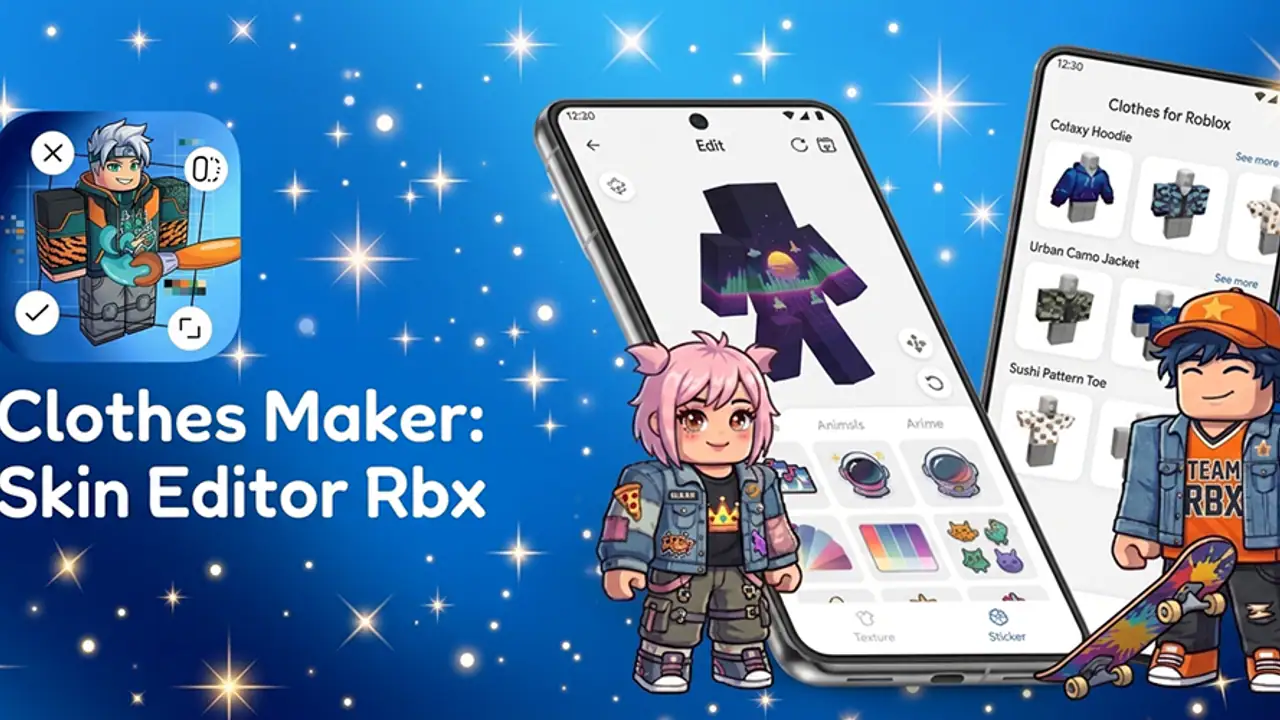
When I tried Skin Editor for RBX, I approached it as a small personalization tool rather than a full game companion. Its purpose is straightforward: help you work on custom RBX skins, shirts, pants, and complete outfits through an editing interface that feels more practical than trying to assemble ideas in a general image editor. That focus is the main reason to consider it. If you want a quick way to experiment with clothing designs for your avatar, it gives you a more direct starting point than a blank canvas.
The app comes from Fromunewa and is listed as a free personalization app for Everyone. It has reached over 100K installs and holds a 4.2 average from around 347 ratings, which suggests that enough people have found the basic concept useful while still leaving room for a mixed experience. I would not treat that score as proof that every workflow is polished, but it does make the app worth examining if you regularly think about changing your character’s look.
What the editing experience is really good for
The strongest use case is planning. I can imagine opening the editor when I have a color combination in mind, want to test a shirt and pants together, or need to turn a rough outfit idea into something easier to review. Instead of repeatedly changing pieces inside the game environment, a dedicated editor lets me concentrate on the visual arrangement first. That separation is useful because it reduces the temptation to make decisions while distracted by everything else happening around an avatar.
The store summary points to custom skins, shirts, pants, and outfits, and those four areas make the app more flexible than a tool limited to one clothing type. A shirt-only editor would be useful for a single design, but outfit work depends on coordination. A top can look excellent by itself and still clash with the lower half, while a strong skin concept may lose its impact when combined with unrelated colors. Working across these elements gives the app a sensible role as a design workspace.
I especially like the idea of treating an outfit as a sequence rather than trying to finish everything in one pass. I would begin with the most important visual feature, such as a bold shirt pattern or a distinctive skin color, then build the rest around it. This prevents the common mistake of adding details simply because the editor makes them available. The practical tip is to decide on one focal point before editing anything else; it makes comparisons easier and helps avoid designs that feel busy.
Related News
Why WhatsApp Messenger Still Makes Everyday Communication Feel Easy

Jurassic World: The Game Is the Better Dino Tycoon for Strategic Players

Threads in Real Life: Who Should Join, Lurk, or Leave

How SHEIN Turned Shopping Into an Endless Content Feed

How to Make Fortnite Feel Smarter on Mobile

Should You Switch to Microsoft Outlook on Mobile?
Another useful workflow is to create variations instead of overwriting the first idea immediately. For example, I might keep the same shirt concept while testing a darker pair of pants and then a lighter one. That small change can reveal whether the design depends on contrast or whether its main detail remains visible in different combinations. Even when an editor is simple, this kind of controlled comparison is more helpful than changing several parts at once and forgetting what improved the result.
Where it fits beside ordinary alternatives
The usual alternative is a general drawing or photo-editing app. Those tools may offer more brushes, layers, filters, and export controls, but they also make you build the clothing layout yourself. For someone who only wants to sketch an RBX shirt or coordinate an outfit, that extra freedom can become friction. A purpose-built editor is easier to approach because the task is already defined around avatar customization.
On the other hand, a general graphics app is the better choice for an artist who needs advanced control over typography, complex shading, precise selections, or a large multi-layer composition. I would not replace a serious illustration workflow with this app. Its appeal is speed and relevance, not the breadth of a professional design suite. The trade-off is clear: less general power in exchange for a workspace shaped around RBX clothing and skins.
Gallery
It also differs from simply browsing ready-made outfits. Browsing is faster when I want an immediate change and do not care about creating a personal concept. Editing becomes more valuable when the goal is to make something distinctive, test an idea, or prepare a coordinated look. Someone who never wants to design anything may find the editor unnecessary, while a user who enjoys visual experimentation will probably get more from it.
Trust begins with what the app visibly asks me to do
Because this is a personalization app, I pay attention to the moments where a design tool might ask for access, an account, or an action outside the editor. The safest habit is to read each visible prompt before accepting it, especially when moving from design work toward sharing, saving, or using a result elsewhere. I would avoid granting access automatically just because a prompt appears during setup.
The app is free, which removes a purchase decision from the first session, but free does not mean I should stop checking what I am agreeing to. I would look at the permission request itself, the wording of any sign-in screen, and whether each requested action makes sense for the task I am performing. If I am only experimenting with a shirt design, a request that seems unrelated deserves a pause rather than an immediate approval.
That is also why I would keep my expectations realistic about account controls. The editor may be useful without becoming a place where I store sensitive personal information, and I would not enter details that are unnecessary for trying its core purpose. If an account step appears, I would use only the information required by that screen and review any choice about visibility or sharing before continuing. The best privacy habit here is simple: give the app only what the current design task genuinely needs.
Practical ways to protect a design workflow
I would begin with a low-stakes test project instead of immediately recreating a design I care about. This lets me learn how editing behaves, how changes are kept, and what the app asks for when I finish. A simple color experiment is enough. If the workflow feels clear, I can then move on to a more detailed outfit without risking confusion about the first session.
I would also keep a personal record of important ideas outside the app. A quick screenshot or a written note about the colors and clothing combination can help if I later want to reproduce the look. This is not because the app is necessarily unreliable; it is a sensible habit whenever a project matters to me and I have not yet established exactly how saving or sharing works in my routine.
For younger users, the Everyone rating makes the app broadly approachable, but I would still encourage an adult to explain the difference between editing a design and sharing information. The age label describes suitability, not a substitute for supervision. A child who only wants to explore colors can stay focused on that activity without connecting unrelated accounts or responding to unfamiliar prompts.
One non-obvious advantage of a focused editor is that it can make design decisions more deliberate. In a general app, I might spend time decorating the canvas instead of improving the clothing concept. Here, the subject remains the avatar look. I would use that limitation intentionally: choose a palette, create one strong detail, coordinate the outfit, and stop when the design communicates its idea clearly.
There is a corresponding limitation. A focused tool can feel restrictive when I want to move beyond the supported clothing and skin concepts. If my project needs elaborate artwork, unusual presentation, or detailed post-processing, I would switch to a broader graphics app after forming the basic idea. In that situation, this editor works best as the planning stage rather than the entire production pipeline.
What the current release means for expectations
The current version is 1.0.1, so I would approach it as an early-stage tool and judge it by whether the central editing path is understandable and useful. I would not expect the same depth, refinement, or range of controls found in long-established creative software. That does not make it a poor choice; it simply means the value depends on whether its focused workflow already matches what I want to do.
The release date is Apr 22, 2026, and that recent timing reinforces my cautious approach. I would try the core task first: make a small skin or clothing concept, coordinate an outfit, and see whether the process feels comfortable. I would only build a larger personal workflow around it after confirming that the way it handles my projects suits me.
For a casual user, this may be enough. Someone who wants to spend a few minutes testing a shirt color or imagining a new avatar style does not necessarily need a deep toolset. The free price makes that experiment easy to justify, and the minimum operating requirement of Android 7.0 means it is available to users with older Android devices as well. I would still judge performance on the actual phone, since an operating-system requirement alone does not tell me how smooth every editing session will feel.
Who should use it and who should pass
I would recommend giving it a try if you enjoy customizing avatars, prefer visual experimentation to browsing finished options, or want a dedicated place to shape RBX clothing ideas. It is also a reasonable choice for a parent looking for an age-appropriate personalization activity, provided the child understands not to approve every prompt or share unnecessary information.
I would be more hesitant to recommend it to someone seeking a complete professional art environment. If you need extensive layers, advanced retouching, detailed export management, or a broad design canvas unrelated to RBX outfits, a general-purpose graphics app will probably serve you better. Likewise, if your priority is instant access to existing looks rather than creating your own, browsing tools are likely faster.
The most useful middle ground is to combine tools thoughtfully. I would use this editor to establish the skin, shirt, pants, and outfit direction, then move to another app only if the final concept needs more artistic finishing. That approach avoids forcing one small personalization app to perform a job it was not designed to handle while still taking advantage of its focused subject matter.
My cautious verdict after using it
Skin Editor for RBX makes sense when the problem I am trying to solve is specific: I want to design or coordinate an avatar look without starting from an entirely blank general-purpose canvas. Its value comes from keeping attention on skins, shirts, pants, and outfits, making it easier to compare ideas and refine a visual direction before committing to a final look.
I appreciate the low barrier created by its free availability and Everyone rating, and the reception from over 100K installs gives it a meaningful audience. Still, I would keep my recommendation measured. The recent version and focused scope mean I would test the editor with a small project first, review every permission or account prompt, and maintain my own backup of anything important.
My final advice is to download it when you want a dedicated RBX customization workspace, not when you need a full illustration studio or a ready-made outfit catalog. Used with that expectation, it can be a convenient and approachable way to turn a vague avatar idea into a more coherent design. The strongest result will come from treating it as a focused creative tool, making careful choices, and keeping control over what you share along the way.
FAQs for Skin Editor for RBX
What is Skin Editor for RBX and what can I use it for?
Skin Editor for RBX is a customization-focused app designed to help users create, edit, and preview character skin ideas inspired by the Roblox avatar style. It can be useful for experimenting with colors, clothing concepts, accessories, and overall outfit combinations before deciding what you want your avatar to look like. It should be viewed as a design and preview tool, not as an official Roblox editor or account-management application.
Is Skin Editor for RBX an official Roblox app?
No. Skin Editor for RBX is a third-party application and is not developed, published, or officially endorsed by Roblox Corporation. During our review, the app appeared focused on avatar-style customization rather than providing direct access to Roblox accounts or official marketplace features. Users should avoid entering their Roblox username, password, payment details, or other sensitive information unless the app clearly explains why that data is required and provides trustworthy privacy documentation.
Can I use the skins or outfits created in the app directly in Roblox?
Usually, creations made in Skin Editor for RBX are intended for designing, previewing, or saving ideas rather than automatically transferring them into a Roblox account. Roblox has its own rules, avatar systems, marketplace limitations, and supported upload procedures. Before expecting an outfit or skin to appear in the game, check whether the app provides an official export option and confirm that the resulting file or design is compatible with Roblox requirements.
Is Skin Editor for RBX free to download and use?
The app may be available to download without an upfront charge, but some features can depend on advertising, in-app purchases, subscriptions, or other restrictions. Availability and pricing may also vary between Android and iOS. Before starting a trial or confirming a purchase, review the store listing carefully, check the renewal terms, and verify which editing tools are included in the free version so there are no unexpected charges.
Is Skin Editor for RBX safe for children and younger users?
Parents should review the app’s age rating, permissions, advertising, privacy policy, and in-app purchase settings before allowing a child to use Skin Editor for RBX. Avatar customization apps can sometimes include external links, promotional content, or optional purchases. It is best to download the application only from a recognized app store, use parental controls where appropriate, and ensure that children do not share account credentials or personal information.
Pros
- Simple tools make basic avatar edits quick and easy.
- Useful for planning outfit ideas before applying them in-game.
- Supports creative customization for players who enjoy styling avatars.
- Lightweight interface is easy to navigate on smaller screens.
- Can help compare different clothing and accessory combinations.
Cons
- Advanced editing options may feel limited for experienced creators.
- Some features or items may require an internet connection.
- Preview results may not always match the game exactly.
- Ads can interrupt browsing or editing sessions.
- Users should review permissions and privacy details before signing in.


